Is Long-Term Variation in GPS Differential Code Biases Caused by Ionospheric Changes? A Review of Foreign Literature
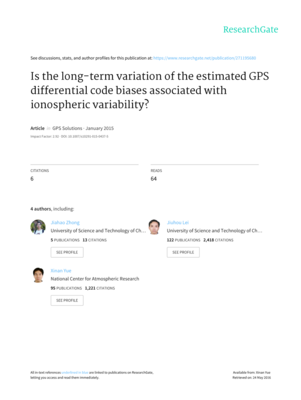
The long-term variation observed in Global Positioning System (GPS) Differential Code Biases (DCBs) is a significant topic in high-precision satellite navigation and space weather research. A review of foreign literature and translation materials indicates a complex relationship between DCB variations and ionospheric changes, but it is not a simple one-way causation.
1. Understanding GPS Differential Code Biases (DCBs)
DCBs refer to the inherent hardware delays between different frequencies (e.g., L1 and L2) within GPS satellites and receivers. These biases must be accurately calibrated to separate instrumental errors from true ionospheric delays when using dual-frequency signals to study the ionosphere or to achieve precise positioning.
2. The Primary Driver: Satellite and Receiver Hardware Stability
The consensus in international research is that the dominant factor influencing long-term DCB trends is the stability and aging of the onboard satellite hardware and ground receiver hardware. Studies analyzing multi-year data from agencies like IGS (International GNSS Service) have shown that DCBs for a given satellite exhibit slow drifts over years, which are highly correlated with satellite age, operational temperature fluctuations, and component aging. These slow variations are intrinsic to the instruments themselves.
3. The Role of Ionospheric Variations: An Indirect and Secondary Influence
While ionospheric changes are not the primary cause of long-term DCB drifts, they play a crucial indirect role:
- Estimation Interference: DCBs are estimated simultaneously with ionospheric parameters (like Total Electron Content - TEC) from observational data. Significant long-term changes in the ionosphere's background state (e.g., due to solar cycle variations) can affect the mathematical separation of these parameters. If not properly modeled, ionospheric trends can alias into or contaminate the estimated DCB time series, making them appear to have ionosphere-related variations.
- Thermal Coupling: The ionospheric environment, particularly during intense space weather events (solar flares, geomagnetic storms), can alter the thermal conditions of the satellite. Changes in absorbed radiation may cause minute, temporary variations in hardware temperature, potentially inducing short-term DCB fluctuations. However, this effect is typically transient and distinct from the secular long-term drift.
- Modeling Challenge: Many ionospheric models assume DCBs are constant over certain periods. Long-term ionospheric changes can expose the inadequacy of this assumption, leading researchers to discover and account for the intrinsic DCB drifts.
4. Key Insights from Translated Research
Translations of seminal papers reveal several important conclusions:
- DCBs must be treated as time-varying parameters, especially for older satellite blocks (e.g., GPS Block IIA).
- Separating genuine hardware drift from ionosphere-induced estimation artifacts requires sophisticated data processing techniques, often involving long-term trend filtering and multi-constellation analysis.
- Studies using data from multiple solar cycles (≈11 years) are essential to disentangle the effects of the solar cycle on the ionosphere from the underlying hardware trends in DCBs.
Conclusion
In summary, according to current international research, long-term variations in GPS DCBs are predominantly caused by the aging and instability of satellite and receiver hardware, not directly by ionospheric changes. However, ionospheric variability acts as a significant complicating factor in the accurate estimation and isolation of these hardware biases. Therefore, understanding long-term DCB behavior requires a holistic approach that concurrently models instrument aging and ionospheric dynamics. Accurate long-term DCB characterization is vital for improving the stability of terrestrial and space-based reference frames, enhancing the precision of global navigation satellite systems (GNSS), and monitoring long-term climate change signals in the upper atmosphere.
如若轉載,請注明出處:http://www.b481.cn/product/15.html
更新時間:2026-06-19 19:54:42